What's New
|
|
|

By Peter Frost Photographs
by Gordon Wiltsie

| Could
this mountain stronghold also have been the home of an earlier, as
yet unknown people? An expedition probes the intriguing ruins of
Cerro Victoria. |
Get
a taste of what awaits you in print from this compelling excerpt.
As our horses climbed the steep, dusty trail, I wondered who was
weariest, the humans or the animals. The horses were stumbling on
the slippery rocks and the mules had that mean glint in their
eyesbut then, so did we. When photographer Gordon Wiltsie's
horse gave a shuddering sigh and actually laid down beneath him, I
decided it was the animals.
We had footslogged three days, sometimes leading our mounts,
sometimes riding, to get to this remote valley in the Vilcabamba
mountains of southern Peru. Plodding in a long, unruly train of
mules and horses42 pack and 9 saddleour animals had bolted,
strayed, and sometimes thrown us, but we needed them. They were
carrying enough gear and supplies to last us a month in the field.
Nine of usarchaeologists, explorers, journalists, and a
cartographerhad started our journey in Cusco, the old Inca
capital. We were joined at the small town of Huancacalle by a
dozen wranglers and their animals, who would help us reach our
goal, Cerro Victoria, a 12,746-foot (3,885-meters) peak in the
southern Vilcabamba Range, where in 2001 our team had found a
previously unknown Inca settlement, Qoriwayrachina.
Remnants of the settlement, whose name is Quechua for "where
wind was used to refine gold"referring to nearby
mineswere scattered over 16 square miles (41 square kilometers)
of steep slopes. They included the remains of more than 200
structures: circular dwellings, agricultural storehouses, roads,
funeral towers, cemeteries, and ceremonial platforms. Although the
ruins lack the grandeur of the lost city of Machu Picchu, 22 miles
(35 kilometers) to the northeast, they raise new questions about
the Inca, whose royalty had withdrawn to the Vilcabamba region in
1537 to wage stubborn warfare against the Spanish. Had
Qoriwayrachina been a refuge for followers of Manco Inca and his
sons, the last Inca kings? Was it also a supply center, channeling
food and precious metals to Choquequirau, the Inca retreat one
valley farther south? Was it built by a previous culture in this
steep, forbidding placeand if so, why?
Get the details of story in the pages of National
Geographic magazine.
|
|
|
|
Machu Picchu: Unveiling
the Mystery of the Incas
A major traveling exhibit in the USA 2004-2005
|

 |
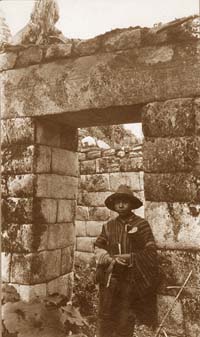
| Hiram Bingham at Machu Picchu.
|
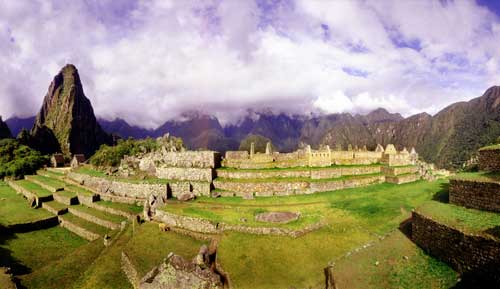
High in the Peruvian cloud forest the Inca
country palace of Machu Picchu is one of the most spectacular archaeological
sites in the world. When local farmers first showed members of the 1911 Yale
Peruvian Expedition to the site, it had survived in a near pristine state since
the Inca abandoned it in the early 16th century.
The Expedition was led by Yale archaeologist
Hiram Bingham (who later became the governor of Connecticut!). He excavated
hundreds of objects that tell the story of everyday life at Machu Picchu and, by
agreement with the Peruvian government, these materials became part of the
Peabody Museums collections. Many of these objects will be on view to the
public for the first time. Together with the 11,000 photographs Bingham took,
they form a unique scientific, historic and artistic resource that enables us to
reconstruct the daily life of Machu Picchu at its zenith 500 years ago.
 |
| One of the 11,000 photographs from the
Yale Peruvian Expeditions. |
Co-curated by Curator of Anthropology
Professor Richard Burger and Curatorial Affiliate and Peruvian archaeologist
Lucy Salazar, this exhibition invites visitors to travel into the past, first to
Machu Picchu with the 1911 Yale Peruvian Scientific Expedition, and then further
back to the late 15th century when this Inca country palace was a bustling
community with an important religious, political and social role in the Inca
empire. The exhibition has many interactive components, including replicas of
the house of the Inca king and an ancient Inca road, a curators tour of the
Inca palace complex, and an interactive laboratory that shows how archaeologists
in the 21st century interpret the 15th century.
Filled with stunning panoramic photographs and
the finest surviving examples of Inca art on loan from Peru, Europe and other
major U.S. collections, this exhibition is not to be missed.
|